

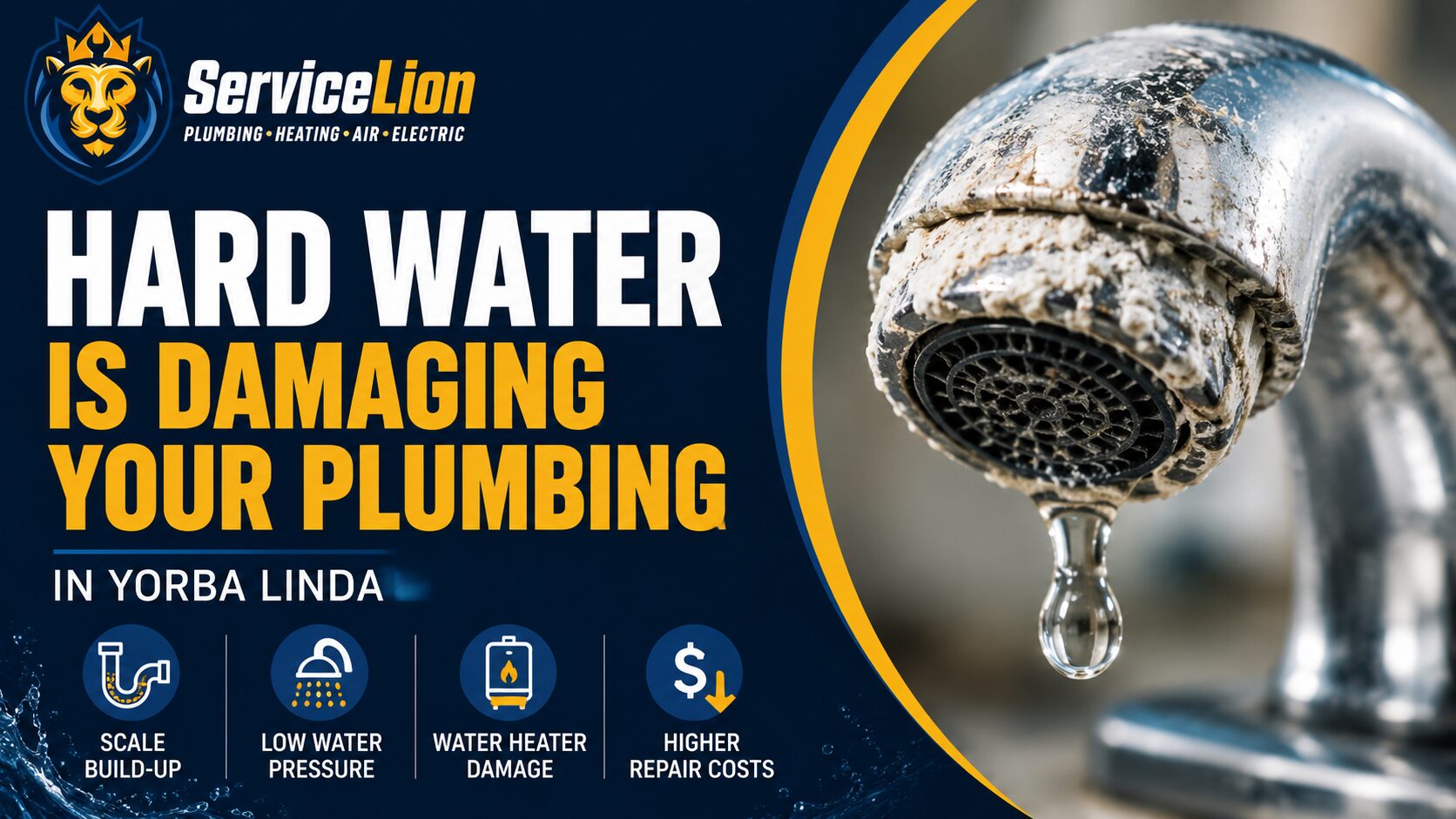
If you’ve noticed white, chalky deposits around your faucets, spots on your dishes after washing, or a thin film that won’t fully rinse off in the shower — that’s hard water at work. And in Yorba Linda, it’s not a rare issue. It’s essentially a given.
Southern California’s water supply carries some of the highest mineral content in the country. That mineral load — primarily calcium and magnesium — is what makes water “hard.” It’s not a health hazard, but it causes real, cumulative damage to your plumbing system, your water heater, your appliances, and your fixtures over time.
Most homeowners don’t connect the dots until something fails.
What “Hard Water” Actually Means
Water hardness is measured in grains per gallon (GPG) or milligrams per liter. Water above 7 GPG is generally considered hard; above 10.5 GPG is very hard. The water supply in much of inland Orange County — including Yorba Linda — regularly tests in the hard to very hard range depending on the season and the source blend.
The minerals themselves aren’t harmful to drink, but they leave deposits everywhere water flows, heats, or evaporates. Over years, those deposits accumulate in ways that cost homeowners real money.
What Hard Water Does to Your Plumbing
Scale Builds Up Inside Your Pipes
Calcium and magnesium deposit on the interior walls of your pipes over time — a process called scaling. In older galvanized steel pipes, this happens faster. In copper pipes, it’s slower but still significant.
Enough scale buildup narrows the effective diameter of your pipes, which reduces water flow and pressure. In severe cases — typically in homes that have never had any water treatment — scale accumulation can clog pipes entirely, particularly at elbows and fittings.
Fixtures and Valves Wear Out Faster
The cartridges and seats inside your faucets and shower valves are designed to seat against smooth surfaces. When mineral deposits build up on those seating surfaces, the valve can’t close cleanly — which leads to dripping faucets, leaky shower valves, and stuck shut-off valves under sinks and behind toilets.
Hard water is a leading reason why faucets and mixing valves in Yorba Linda homes need to be replaced more frequently than they would in areas with softer water.
Your Water Heater Works Harder and Dies Sooner
This is where hard water causes some of its most significant damage. Calcium deposits settle at the bottom of tank water heaters as the water is heated — creating a layer of sediment that insulates the burner or heating element from the water above it. The system has to work harder to heat water through that layer, which wastes energy and accelerates wear.
That popping and rumbling sound in your water heater? That’s often trapped water boiling beneath a crust of mineral sediment. It’s not immediately dangerous, but it signals reduced efficiency and a shorter remaining lifespan.
Tankless water heaters are also vulnerable — scale builds up on the heat exchanger, reducing flow and efficiency. They need descaling more frequently in hard water areas.
Appliances Take a Hit Too
Dishwashers, washing machines, ice makers, and coffee makers all move water through small passages, valves, and heating elements. Hard water scale clogs those passages, reduces heating efficiency, and shortens appliance life. The chalky film you see on dishes coming out of the dishwasher is calcium residue that the detergent didn’t fully dissolve.
How to Tell If Hard Water Is Affecting Your Home
- White or yellowish deposits around faucets, showerheads, or drains
- Spots on dishes, glassware, and stainless steel
- Soap that doesn’t lather well or rinses off poorly
- Reduced water flow from showerheads or faucets
- A water heater that’s louder than it used to be or heating more slowly
- Stiff, scratchy laundry even after washing
- Frequent faucet drips or leaky valves
What You Can Do About It
The most effective solution is a whole-house water softener, installed where the main water supply enters the home. A water softener uses an ion exchange process to remove calcium and magnesium from the water before it reaches your pipes, fixtures, and appliances.
Benefits homeowners notice quickly:
- No more mineral deposits on fixtures
- Soap lathers more easily
- Clothes come out of the wash softer
- Water heater runs more quietly and efficiently
- Faucets and valves last longer
For homes where a softener isn’t practical, a descaling filter or a magnetic conditioner can reduce some effects — though they’re less effective than true ion exchange softening.
Hard water is one of those slow-moving problems that’s easy to ignore because nothing breaks dramatically on day one. It works on your pipes, water heater, fixtures, and appliances year after year until something finally gives out. In Yorba Linda, where the water supply is consistently hard, taking steps to address it proactively is simply good home maintenance.
Service Lion Plumbing Heating Air Electric installs and services whole-house water softeners throughout Yorba Linda and Orange County. If you’d like to talk through your options, call (657) 530-5808 or schedule a visit online.
FAQ
Is Yorba Linda’s water actually hard?
Yes. Inland Orange County water — including what’s distributed in Yorba Linda — is consistently in the hard to very hard range. This varies somewhat by season and water source, but hard water conditions are the norm, not the exception.
Can hard water damage be reversed?
Some of it, yes. Descaling treatments can remove buildup from water heaters. New faucet cartridges can fix dripping valves. But the cumulative damage to pipes over decades can’t be fully undone — prevention is more effective than repair.
Does a water softener affect drinking water taste?
Softened water has slightly higher sodium content due to the ion exchange process. Many homeowners add a reverse osmosis filter at the kitchen sink for drinking and cooking water if this is a concern.
How much does a water softener cost to install?
Whole-house water softener installation typically runs $800–$2,500 depending on the system size and complexity of the installation. The savings on appliance replacement, plumbing repairs, and reduced soap/detergent usage offset the cost over time for most households.
How often does a water softener need maintenance?
The main ongoing task is adding salt to the brine tank — frequency depends on water usage and system size, typically monthly. The system itself should be serviced every 1–2 years.